Brewing




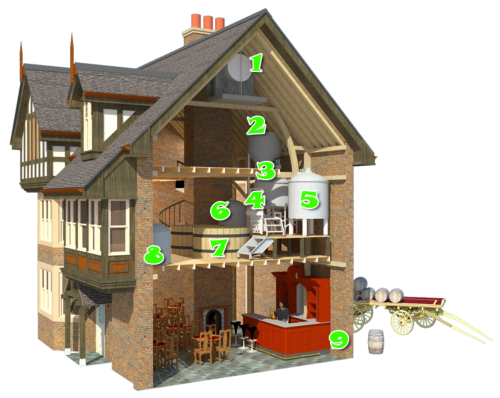
The beer is stored in 'Casks' NOT 'Barrels'. A barrel is a size
of cask



The art of brewing
1.
Hot Liquor Tank
Water is boiled overnight in the hot liquor tank, ready for brewing the next
day
2.
Grist Case
Malt (milled barley) is stored in the Grist Case and added to the Mash
Tun with the hot water.
3.
Mash Tun
The 'mash' is mixed for one and a half hours in the Mash Tun
4.
Under Back
The mash is run off through the Under Back and is now called 'Wort'
5.
Copper
The mixture is boiled in the Copper for two hours where hops are added
to the mixture.
6.
Hop Back
The mixture is cooled in the Hop Back to twenty degrees centigrade.
7.
Fermenting Vats
After 30 minutes the mixture is run off into the Fermenting Vats. Yeast is
added and the brew left to ferment for 6 days.
8.
Racking Tank
The yeast is skimmed off and the beer is transferred to the Racking Tank
and left for 12 hours.
9.
Casks
The beer is racked into casks and stored for a week before being used.

Brewing is the process of making beer or other fermented beverages through the fermentation of sugars by yeast. The basic brewing process involves several
key steps:
1. Malting:
The process starts with malted grains, usually barley. Barley grains are soaked in water, allowed to germinate, and then dried in a kiln. This process activates
enzymes that convert the starches in the grains into fermentable sugars. Other grains like wheat, corn, or rice can also be used in brewing.
2. Mashing:
The malted grains are mixed with hot water in a large vessel called a mash tun. This creates a porridge-like mixture called mash. The heat activates enzymes in
the malt, which break down the starches into sugars. The result is a sugary liquid called wort.
3. Boiling:
The wort is transferred to a kettle and boiled. Hops, the flowers of the hop plant, are added during the boil. Hops contribute bitterness, aroma, and flavor to the
beer and also act as a natural preservative. The timing of hop additions during the boil influences the beer's bitterness and aroma profile.
4. Cooling:
After boiling, the hot wort needs to be cooled down quickly to a temperature suitable for fermentation. This is usually done using a heat exchanger that passes
the hot wort through coils or plates, with cold water running in the opposite direction, cooling the wort.
5. Fermentation:
The cooled wort is transferred to a fermentation vessel, typically a large, airtight container. Yeast is added to the wort, and fermentation begins. Yeast consumes
the sugars in the wort and produces alcohol and carbon dioxide. There are two main types of fermentation: ale fermentation, which occurs at warmer
temperatures (around 60-75°F or 15-24°C), and lager fermentation, which occurs at cooler temperatures (around 45-55°F or 7-13°C).
6. Maturation and Conditioning:
After the initial fermentation, the beer is often left to mature and condition. This allows the flavours to mellow and develop complexity. Maturation can take place
in the same fermentation vessel or be transferred to another vessel for conditioning.
7. Carbonation:
After fermentation and maturation, the beer might be carbonated. This can happen naturally through the fermentation process or by adding additional sugar to
the beer before bottling or kegging. The carbonation creates the bubbles in the beer.
8. Packaging:
The final step involves packaging the beer for distribution and consumption. Beer can be bottled, canned, or kegged, ready to be enjoyed by people around the
world.
It's important to note that there are various styles and techniques in brewing, leading to a wide variety of beers with different flavours, aromas, and
characteristics. Brewers often experiment with ingredients and processes to create unique and diverse beer experiences and home brew pubs often have a wider
range of flavours than commercial breweries.
 Pubs
Pubs Open Map in New Window
 England
 Scotland
 Wales
Wales Ireland
 County Map
 About Britain
 Pubs
Pubs British Beer
 Perfect Pint
 Beer Glasses
 The Barren Years
 Real Fires
 Breweries
 Brewing
 British Food
 Recipes
 Pub Interiors
 Dog Friendly
 Pub Games
 Strange Pub Names
 Visitor Information
 Oldest Pub
 Pub Signs
 Micropubs
 Buildings
 Cathedrals
 Stately Homes
 Castles
 Listed Buildings
 Scheduled Monuments
 Oak Framing
 Architecture
 Thatching
 Waterways
 Sailing
 Shipbuilding
 Boatbuilding
  Shipping Forecast
 Britain's Coastline
 Coastal Locations
 Piers
Piers Lighthouses
 Harbours
 Beach Safety
 British Beaches
 Canals
 Rivers
 Islands
 Lakes
Lakes Waterfalls
 Historical
 Famous People
 Kings & Queens
 Kings of England
 History of Britain
 Industrial Revolution
 Act of Union
 Beaufort Scale
 British Firsts
 World Heritage Sites
 Historical Periods
 Historical Boundaries
 Tradition & Culture
 Morris Dancing
 Film & Television
 Television
 Calendar of Events
 British Sport
 Scottish Highlands
 Money
Money Dry Stone Walling
 British Wildlife
 Class System
 Geographical
 Pub Boundaries
 Facts 'n' Figures
 British Isles
 Other Areas
 Place Name Origins
 Topography
 Suggest an Inn
 Explanation of symbols
 Why Us?
 Places to Visit
 Long Distance Paths
 National Parks
 Areas of Outstanding Natural Beauty
 Coastal Locations
 Other areas of Britain
 Maps
Maps Our Favourite Locations
 Search
 Focus On...
 News
News Contact
 About Us
 Our History
 Donate