British Money
The history of British money dates back over a thousand years and has undergone many
transformations, from early silver pennies to today’s modern banknotes and digital payments.
Early Anglo-Saxon Coinage (c. 600–1066)
• Before coins, trade was conducted using barter and foreign currency, such as Roman and Frankish coins. • The first native English coins appeared around 675 AD - small silver sceattas used mainly in trade. • By the 8th century, the silver penny became the dominant coin and remained the primary unit for centuries. • Coins were often minted locally by moneyers, who worked under royal authority.The Medieval Period (1066–1485)
• After the Norman Conquest (1066), the silver penny remained dominant. • Gold coins appeared in the 13th century, like the gold noble (worth 6s 8d). • Edward III introduced the first English gold florin and later the gold noble. • Coins were often clipped or counterfeited, leading to strict laws against tampering. • The pound sterling (£) was established as a unit of account.Tudor & Stuart Era (1485–1714)
• Henry VII introduced the first shilling and sovereign coin. • Henry VIII debased the coinage (reducing silver content), leading to inflation. • Elizabeth I reformed the coinage, restoring its silver content. • The first official British banknotes appeared under the reign of Charles II in the late 1600s. (issued by goldsmith bankers).The Shift to Milled Coinage (1662)
• Before the 17th century, coins were hammered by hand, making them irregular. • Under Charles II, machine-milled coins were introduced, improving security.The Establishment of the Bank of England (1694)
• Founded to fund war efforts against France, the Bank of England began issuing banknotes that were initially handwritten. • By the early 18th century, banknotes became more common, though they were mostly used for large transactions.The 18th & 19th Century Reforms
• In 1717, Sir Isaac Newton (as Master of the Royal Mint) fixed the gold standard, linking the pound to a set value of gold. • In 1821, Britain formally adopted the gold standard, making the pound directly convertible to gold. • The first modern machine-minted coins appeared in the 19th century.20th Century: The End of the Gold Standard & Decimalisation
• The gold standard was abandoned in 1931 due to economic pressures. • Banknotes replaced gold coins for everyday transactions. • In 1971, Britain decimalised its currency, switching from the old system (pounds, shillings, pence) to the modern 100 pence = £1 system. Old English money, used before decimalization in 1971, was based on a system of pounds (£), shillings (s.), and pence (d.). This system, known as £sd, had its roots in medieval times and was derived from Roman and Carolingian influences.Basic Units of Currency
Pound (£, Libra) – The highest standard unit of currency. Shilling (s.) – 1/20 of a pound (12 pence). Penny (d., Denarius) – 1/12 of a shilling or 1/240 of a pound.Subdivisions and Other Coins
Decimalization and the End of the Old System
On February 15, 1971, Britain switched to a decimal system, where 100 new pence made up a pound, replacing the old complex structure. The pre-decimal coins were gradually phased out, though some (such as the sixpence) remained in circulation for a while.Modern British Money
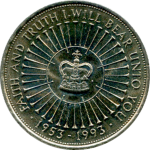
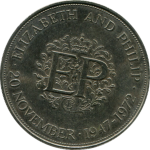
• The Bank of England issues polymer banknotes featuring famous figures (e.g., Queen Elizabeth II, Winston Churchill). • Coins have evolved in design, featuring different monarchs and commemorative editions. • Contactless payments and digital banking have become dominant in the 21st century. The Royal Mint has issued many other special coins such as the Crowns above for the 1977 Jubilee, Queen Mother 80th birthday in 1980 and Charles and Diana’s Wedding in 1981 There was also the Churchill Crown of 1965, Queen Elizabeth’s Silver Wedding in 1972, the first 50 pence piece 1973, first two pound coin in 1986, and a £5 coin for Queen Elizabeth’s 40 year reign in 1993 Many historical figures have appeared on the bank notes over the years.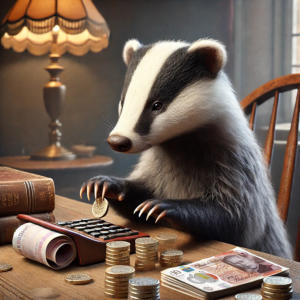
Coins
Farthing (¼ of a penny)
Halfpenny (½ of a penny)
Penny (d., Denarius) – 1/12 of a shilling or
1/240 of a pound.
Threepence (3d.) – A small silver coin, later
minted in nickel-brass.
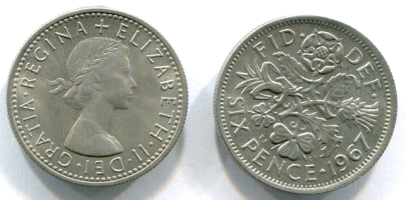
Sixpence (6d.) – Known as a "tanner," worth
half a shilling.
Shilling (1s.) – Called a "bob."
Florin (2s.) – Equivalent to 10% of a pound.
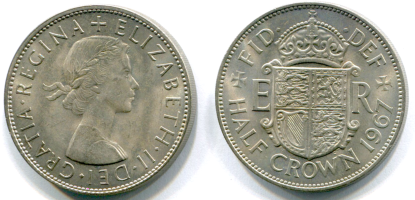
Half Crown (2s. 6d.) – Worth two and a half
shillings.
Crown (5s.) – A large silver coin, mainly
ceremonial by the 20th century.
Sovereign (£1) – A gold coin worth one
pound.
Guinea (21s.) – Originally a gold coin, the
guinea was valued at 21 shillings and was
often used for luxury goods, professions,
and horse trading.
Notes






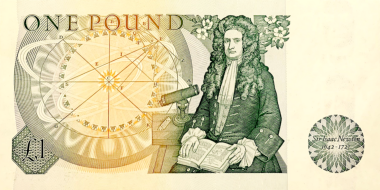


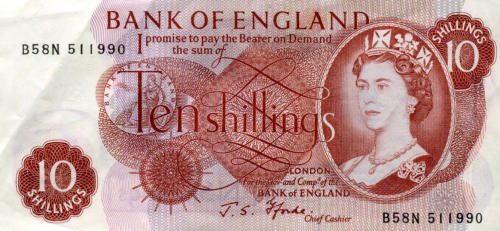





Series D
Value
Historical figure
Issued
Series E
Value
Historical figure
Issued
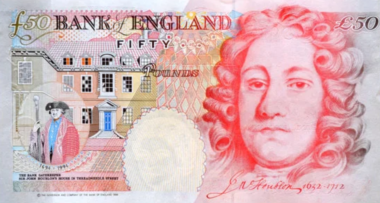
£50
Sir John Houblon
1994
Series E (Variant)
Value
Historical figure
Issued
£5
Elizabeth Fry
2002
Series G
Value
Historical figure
Issued

 Pubs
Pubs Open Map in New Window
 England
 Scotland
 Wales
Wales Ireland
 County Map
 About Britain
 Pubs
Pubs British Beer
 Perfect Pint
 Beer Glasses
 The Barren Years
 Real Fires
 Breweries
 Brewing
 British Food
 Recipes
 Pub Interiors
 Dog Friendly
 Pub Games
 Strange Pub Names
 Visitor Information
 Oldest Pub
 Pub Signs
 Micropubs
 Buildings
 Cathedrals
 Stately Homes
 Castles
 Listed Buildings
 Scheduled Monuments
 Oak Framing
 Architecture
 Thatching
 Waterways
 Sailing
 Shipbuilding
 Boatbuilding
  Shipping Forecast
 Britain's Coastline
 Coastal Locations
 Piers
Piers Lighthouses
 Harbours
 Beach Safety
 British Beaches
 Canals
 Rivers
 Islands
 Lakes
Lakes Waterfalls
 Historical
 Famous People
 Kings & Queens
 Kings of England
 History of Britain
 Industrial Revolution
 Act of Union
 Beaufort Scale
 British Firsts
 World Heritage Sites
 Historical Periods
 Historical Boundaries
 Tradition & Culture
 Morris Dancing
 Film & Television
 Television
 Calendar of Events
 British Sport
 Scottish Highlands
 Money
Money Dry Stone Walling
 British Wildlife
 Class System
 Geographical
 Pub Boundaries
 Facts 'n' Figures
 British Isles
 Other Areas
 Place Name Origins
 Topography
 Suggest an Inn
 Explanation of symbols
 Why Us?
 Places to Visit
 Long Distance Paths
 National Parks
 Areas of Outstanding Natural Beauty
 Coastal Locations
 Other areas of Britain
 Maps
Maps Our Favourite Locations
 Search
 Focus On...
 News
News Contact
 About Us
 Our History
 Donate