



Locations
Hover over the dots to reveal the place name and click to read more information.
Favourites
These are just a few of our favourites - we’ll be adding more as and when we have a bit of spare time.




They can be found across the United Kingdom, with a particularly high concentration in Scotland, Wales, the Lake District, the Yorkshire Dales, and the Pennines.
Many waterfalls in these regions were formed by glacial activity, which carved out deep valleys and left behind "hanging valleys" where streams continue to flow.
The names of waterfalls often reflect their location or characteristics, with "force" and "foss" being common terms in northern England, and "linn" or "spout" found
elsewhere.
Highest Waterfalls
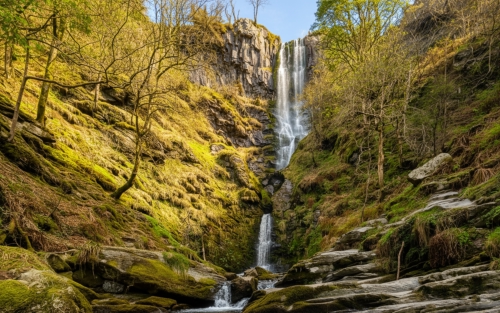
• Eas a' Chual Aluinn, Scotland: Located in the Scottish Highlands, this is the highest waterfall in the UK. Tucked away in the wilds of Assynt, Sutherland in the Scottish Highlands, this remote cascade plunges a staggering 200 metres (660 feet) down a sheer cliff face - nearly four times the height of Niagara Falls. Derived from Scottish Gaelic Eas a' Chùil Àlainn, meaning “waterfall of the beautiful tresses”. It’s not visible from the road - you’ll need to earn the view. The hike is about 10 km (6 miles) round trip across boggy terrain, starting roughly 5 km south of Kylesku. The landscape around Eas a’ Chual Aluinn is pure Highland drama - windswept moors, looming cliffs and the haunting silence of true wilderness. It’s the kind of place where you half expect a spectral stag to appear through the mist or a badger to offer you a flask of tea and a map. • Cautley Spout, England: Cautley Spout is England’s tallest above-ground waterfall - a dramatic, multi-tiered cascade tumbling nearly 200 metres (650 feet) down the rugged cliffs of the Howgill Fells in Cumbria. It’s wild, remote, and utterly breathtaking. It’s a cascade waterfall, meaning the water flows down a series of rocky steps rather than one sheer drop. The falls sit at the head of a glacial valley beneath The Calf, the highest peak in the Howgill Fells. The landscape is stark and sweeping - think Tolkien meets Yorkshire grit. Fed by a tributary of the River Rawthey, the spout is visible from a distance, especially when the water’s in full flow after rain. It’s one of those places where you half expect a badger in hiking boots to offer you flapjack and folklore. • Pistyll Rhaeadr, Wales: Tucked away in the Berwyn Mountains, this is the tallest waterfall in Wales, standing at 73 meters (240 ft) high. The waterfall is fed by the Afon Disgynfa, which plunges over a Silurian cliff face in three stages before becoming the Afon Rhaeadr. Tan-y-Pistyll (“little house under the waterfall”) is a charming tea room and guesthouse with views of the falls and a cosy log fire for colder days. There are trails for all levels—from gentle circuits to steep climbs up the waterfall’s side and into the Berwyn ridge. Above the falls lies Llyn Luncaws, a remote lake steeped in local legend. The name “Pistyll Rhaeadr” comes from Welsh: pistyll meaning “spout” or “spring,” and rhaeadr meaning “waterfall”. As you would expect, most waterfalls can be found at the end of a long trek but Pistyll Rhaeadr has a car park and cafe - it’s not very big and a very narrow lane to get to it though.Other Notable Waterfalls
• High Force, England: Located on the River Tees in County Durham, this is England's most powerful waterfall. It has a single drop of 21 meters (70 ft) over a dolerite rock formation. ** Our High Force photo is a little upsetting for us. It was taken in 1982 and taken to a photo processing lab in Wolverhampton to be blown up to a 10x8” print along with a photo of Freddie Mercury and one of Brian May from Queen. The Photo Lab had a break in and our negatives were lost. • Hardraw Force, England: England’s tallest above-ground single-drop waterfall, plunging a dramatic 100 feet (30 metres) into a rocky gorge in the heart of the Yorkshire Dales National Park It’s a place where nature, history, and cinematic flair collide - quietly tucked behind a pub, no less. o Formed by: Hardraw Beck, a tributary of the River Ure. o Drop: A sheer vertical plunge over limestone, creating a thunderous curtain of water after heavy rain. o Setting: Surrounded by 15 acres of wooded grounds, the gorge forms a natural amphitheatre—perfect for echoing brass bands or poetic musings. Entrance is through the historic Green Dragon Inn, a 13th-century pub with serious character. You pay a small fee to access the waterfall via a path beside the inn. Featured in Robin Hood: Prince of Thieves (1991) - yes, the scene where Maid Marian catches Kevin Costner’s Robin Hood bathing beneath the falls. Sketched by J.M.W. Turner in 1816 and visited by William Wordsworth in 1799, who mentioned it in his Guide to the Lakes. The name “Force” comes from the Norse foss, meaning waterfall - so saying “Hardraw Force Waterfall” is technically “Hardraw Waterfall Waterfall”. But hey, it’s got enough drama to deserve the double billing. • Aysgarth Falls, England: Also in the Yorkshire Dales, these are not a single waterfall but a series of three wide, stepped waterfalls on the River Ure. o Upper Falls: Broad limestone steps with dramatic flow, especially after rain. o Middle Falls: Often considered the most photogenic, with layered drops and woodland framing. o Lower Falls: The most secluded, offering a quieter, more contemplative vibe. Together, they drop around 200 feet (61 metres), making them one of the most impressive waterfall systems in England. Aysgarth Falls has inspired artists and poets for centuries - Turner, Wordsworth and Ruskin all sang its praises. It starred in Robin Hood: Prince of Thieves and Wuthering Heights, adding cinematic flair to its natural drama. • Steall Falls, Scotland: A stunning waterfall in Glen Nevis, it plunges 120 meters into the Nevis Gorge and is known for its dramatic rope bridge crossing. • Waterfall Country, Wales: This is a famous area in the Brecon Beacons National Park, where the "Four Falls Trail" allows hikers to visit a series of waterfalls, including Sgwd-yr-Eira, which you can walk behind. • Aberdulais Falls, Wales: Spectacular natural and industrial heritage site tucked into the steep-sided gorge of the River Dulais near Neath, South Wales. It’s not just a pretty waterfall - it’s a place where geology, history, and green energy collide in dramatic fashion. The falls were carved out around 20,000 years ago by glacial meltwater, slicing through 300-million-year-old Pennant sandstone. The River Dulais is a flash flood river, meaning it can swell dramatically after rain, turning the falls into a roaring spectacle. Wildlife thrives here - expect to spot Daubenton’s bats, dippers, wagtails, and herons on quieter days. Since 1584, the power of the falls has been harnessed for industry—starting with copper production, then corn milling, and later tinplate manufacturing. The site features one of Europe’s largest electricity-generating waterwheels, measuring 8.2 meters in diameter with 72 buckets. It turns at a stately five revolutions per minute • Aira Force, England: Located in the Lake District, this is one of the most popular waterfalls in the area, with a beautiful cascade and a network of trails. • Smoo Cave waterfall, Scotland: One of Scotland’s most dramatic and unusual natural spectacles—like something out of a Viking saga crossed with a fantasy novel. It’s the only cave in the UK formed by both sea and freshwater erosion. The massive entrance (40m wide, 15m high) was carved by the sea, while the inner chambers—where the waterfall lives—were sculpted by freshwater from the Allt Smoo stream. The Allt Smoo drops through a sinkhole in the limestone roof into the second chamber, creating a thundering underground waterfall. When rainfall is heavy, it becomes a roaring torrent that floods the cave and halts tours. The cave has a vast main chamber, a waterfall chamber, and a third inner chamber only accessible by boat during guided tours. • Janet's Foss, England: A picturesque waterfall near Malham in North Yorkshire, it is named after Janet, the queen of the fairies, who is said to live in a cave behind the falls. A gentle plunge waterfall, where Gordale Beck flows over a limestone ledge topped with tufa (a porous rock formed by lime-rich water). The plunge pool below was traditionally used for sheep dipping, which turned into a local social event - imagine villagers gathering with snacks and gossip while sheep got their spa treatment. Best accessed via the Malham Landscape Trail, a scenic walk from Malham village through fields and woodland. It’s about 3 miles (4.8 km) round trip and moderately easy. • Kinder Downfall, England: The Peak District’s tallest and most dramatic cascade. At about 30 metres (98 feet), perched on the edge of the Kinder Scout plateau, the highest point in the national park at 636m. Formed by the River Kinder as it plunges over gritstone cliffs, on windy days, the water gets blown upwards, back into the air - creating a surreal misty plume that can be seen from miles away. • Becky Falls, England: Wild and wonderful slice of Dartmoor magic - where ancient woodland, granite boulders and cascading water come together in a landscape that feels both prehistoric and storybook- worthy. The main waterfall drops around 70 feet (21 metres) and spreads over 35 feet wide in places. Formed by Becka Brook, which tumbles through a boulder-strewn valley before joining the River Bovey, the landscape was carved out during the last Ice Age, over 12,000 years ago. The site is a Site of Special Scientific Interest (SSSI), home to rare flora, fauna and ancient woodland. There are three circular trails: o Blue Trail: Gentle, family-friendly, and includes a Children’s Nature Challenge. o Red Trail: Leads to the main waterfall and includes a boulder scramble. o Purple Trail: Rugged and scenic, with views of the lower falls • Swallow Falls, Wales: Known in Welsh as Rhaeadr y Wennol or Rhaeadr Ewynnol - is one of North Wales’ most iconic and photogenic waterfalls, where the River Llugwy tumbles through a narrow rocky gorge in a series of foaming cascades. It’s dramatic, accessible, and steeped in both natural beauty and local lore. At around 42 metres (138 feet) in total drop, making it one of the tallest continuous waterfall systems in Wales, Swallow Falls is a cascade waterfall, with multiple drops and channels that split and rejoin - like a watery braid unravelling over the rocks. Rhaeadr y Wennol means “the swallow’s waterfall,” inspired by the way the water splits like a swallow’s tail. Rhaeadr Ewynnol means “the foaming waterfall,” a later poetic coinage to emphasize its frothy drama. Located just outside Betws-y-Coed along the A5, it is accessed by a turnstile with an entrance fee although the river continues to fall over rocks right into Betws-y-Coed where there are plenty of places around the Pont-y-Pair bridge for viewing and photo opportunities. • Kilt Rock Waterfall - more precisely, Mealt Falls, Scotland: One of the Isle of Skye’s most iconic and surreal sights, where geology and gravity team up for a dramatic seaside spectacle. A 90-metre-high cliff made of basalt columns and dolerite sills, which resemble the pleats of a traditional Scottish kilt. The reddish sandstone between the columns even gives it a tartan-like hue. A 55-metre waterfall plunges straight off the cliff into the sea below. It’s fed by Loch Mealt, a freshwater loch just inland. The combination of vertical rock folds and a sheer drop into the Sound of Raasay makes this one of the most photogenic spots in Scotland. The name “Kilt Rock” comes from the Gaelic Creag an Fheilidh, meaning “Rock of the Kilt”. The area’s Norse name, Stafr, means “place of pillars” - a nod to the Viking influence and the geological grandeur.




UK map of the Fat Badgers favourite waterfalls
British waterfalls are often characterised by their location in the country's mountainous and upland regions, where rivers and streams tumble over
hard rock formations so governed by Britain’s Geology and Topography.















 Pubs
Pubs Open Map in New Window
 England
 Scotland
 Wales
Wales Ireland
 County Map
 About Britain
 Pubs
Pubs British Beer
 Perfect Pint
 Beer Glasses
 The Barren Years
 Real Fires
 Breweries
 Brewing
 British Food
 Recipes
 Pub Interiors
 Dog Friendly
 Pub Games
 Strange Pub Names
 Visitor Information
 Oldest Pub
 Pub Signs
 Micropubs
 Buildings
 Cathedrals
 Stately Homes
 Castles
 Listed Buildings
 Scheduled Monuments
 Oak Framing
 Architecture
 Thatching
 Waterways
 Sailing
 Shipbuilding
 Boatbuilding
  Shipping Forecast
 Britain's Coastline
 Coastal Locations
 Piers
Piers Lighthouses
 Harbours
 Beach Safety
 British Beaches
 Canals
 Rivers
 Islands
 Lakes
Lakes Waterfalls
 Historical
 Famous People
 Kings & Queens
 Kings of England
 History of Britain
 Industrial Revolution
 Act of Union
 Beaufort Scale
 British Firsts
 World Heritage Sites
 Historical Periods
 Historical Boundaries
 Tradition & Culture
 Morris Dancing
 Film & Television
 Television
 Calendar of Events
 British Sport
 Scottish Highlands
 Money
Money Dry Stone Walling
 British Wildlife
 Class System
 Geographical
 Pub Boundaries
 Facts 'n' Figures
 British Isles
 Other Areas
 Place Name Origins
 Topography
 Suggest an Inn
 Explanation of symbols
 Why Us?
 Places to Visit
 Long Distance Paths
 National Parks
 Areas of Outstanding Natural Beauty
 Coastal Locations
 Other areas of Britain
 Maps
Maps Our Favourite Locations
 Search
 Focus On...
 News
News Contact
 About Us
 Our History
 Donate