
The creative use of brick bonding in architecture, with or without contrasting or complementary brick colours, can
have a dramatic effect on the appearance of a building.
In recent times stretcher bond has predominated, mainly because of the speed with which it can be laid in cavity
wall construction. There are, however, other traditional methods which can be used to enrich large areas of
brickwork, although extra cutting is needed.
English Bond
Alternative courses of headers and stretchers; one header placed centrally above each stretcher. This is a very
strong bond when the wall is 1 brick thick (or thicker)
Flemish Bond
Alternate bricks are placed as header and stretcher in every course. Each header is placed centrally between the
stretcher immediately above and below. This is not as strong as the English bond at 1 brick thick
English Garden Wall Bond
An alternative version of English bond with header courses being inserted at every fourth or sixth course. This is a
correspondingly weaker bond.
Flemish Garden Wall Bond
Like English Garden Wall bond, this was originally intended for use in solid walls which were required to be
fair faced both sides.
The number of stretchers is increased and three stretchers are laid to one header in each course.
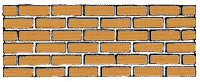
Stretcher Bond
Originally used for single brick walls, now called 1/2 brick walls it became the obvious choice for cavity walls as
less cutting was required.
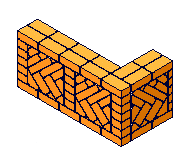
Raking Bonds
Herringbone and diagonal bonds can be effective within an exposed framed construction, or contained within
restraining brick courses.
Quantities
Figures are assuming one header per brick. English and Flemish bonds are attractive for dwarf and retaining walls
where only one good face is required. Stretcher bond is the most economical of all. To create a wall which is fair-
faced on both sides, two stretcher walls are built side by side with a continuous mortar joint between them, the two
walls being bonded together with ties (these are also called collar jointed walls). Snap headers are a simple way of
adding variety.
One square metre of brickwork, a half brick
thick, requires the following number of bricks:
English bond 86
Flemish Garden Wall bond 67
Flemish bond 77
Stretcher bond 60
English Garden Wall bond 72





 Pubs
Pubs Open Map in New Window
 England
 Scotland
 Wales
Wales Ireland
 County Map
 About Britain
 Pubs
Pubs British Beer
 Perfect Pint
 Beer Glasses
 The Barren Years
 Real Fires
 Breweries
 Brewing
 British Food
 Recipes
 Pub Interiors
 Dog Friendly
 Pub Games
 Strange Pub Names
 Visitor Information
 Oldest Pub
 Pub Signs
 Micropubs
 Buildings
 Cathedrals
 Stately Homes
 Castles
 Listed Buildings
 Scheduled Monuments
 Oak Framing
 Architecture
 Thatching
 Waterways
 Sailing
 Shipbuilding
 Boatbuilding
  Shipping Forecast
 Britain's Coastline
 Coastal Locations
 Piers
Piers Lighthouses
 Harbours
 Beach Safety
 British Beaches
 Canals
 Rivers
 Islands
 Lakes
Lakes Waterfalls
 Historical
 Famous People
 Kings & Queens
 Kings of England
 History of Britain
 Industrial Revolution
 Act of Union
 Beaufort Scale
 British Firsts
 World Heritage Sites
 Historical Periods
 Historical Boundaries
 Tradition & Culture
 Morris Dancing
 Film & Television
 Television
 Calendar of Events
 British Sport
 Scottish Highlands
 Money
Money Dry Stone Walling
 British Wildlife
 Class System
 Geographical
 Pub Boundaries
 Facts 'n' Figures
 British Isles
 Other Areas
 Place Name Origins
 Topography
 Suggest an Inn
 Explanation of symbols
 Why Us?
 Places to Visit
 Long Distance Paths
 National Parks
 Areas of Outstanding Natural Beauty
 Coastal Locations
 Other areas of Britain
 Maps
Maps Our Favourite Locations
 Search
 Focus On...
 News
News Contact
 About Us
 Our History
 Donate