The Magna Carta, also known as the Great Charter, is one of the most significant legal documents in
history. It was sealed by King John of England on June 15, 1215, at Runnymede, near the River Thames
in Surrey.
The Magna Carta established the principle that everyone, including the king, was subject to the law, and it
laid the foundations for constitutional governance and the protection of individual rights. Its influence has
extended far beyond England, shaping legal systems and concepts of liberty around the world.
Background of the Magna Carta:
1. King John’s Reign:
• Tyrannical Rule: King John (reigned 1199-1216) is often remembered as one of England's more unpopular monarchs. His reign was marked by military failures, particularly the loss of English territories in France, and by heavy taxation to fund his unsuccessful wars. His arbitrary use of power, including the exploitation of feudal rights, led to widespread discontent among his barons. • Rebellion: The barons, frustrated by King John's abuses of power, including his demands for money and land, eventually rebelled. They sought to limit the king's authority and protect their own rights and privileges.2. The Road to Runnymede:
Civil Unrest: By 1215, tensions between the king and the barons had reached a breaking point. The barons captured London and forced King John to negotiate. The negotiations led to the drafting of a charter that aimed to address the grievances of the barons and limit the king's power.The Agreement at Runnymede:
On June 15, 1215, King John met the rebel barons at Runnymede, a meadow by the River Thames. There, he agreed to the terms set out in the Magna Carta, effectively conceding to the demands of his barons in order to avoid civil war.Key Provisions of the Magna Carta:
The original Magna Carta contained 63 clauses, many of which addressed specific grievances of the barons. While some of the provisions were highly specific to the circumstances of the time, others have had a lasting impact on the development of law and government.Rule of Law:
The Magna Carta established the principle that the king and his government were not above the law. It limited the king's ability to act arbitrarily, ensuring that he had to govern according to established laws and customs.Protection of Rights:
The charter guaranteed certain rights to the barons and, by extension, to other free men. This included protection from unlawful imprisonment, access to swift justice, and limits on feudal payments to the Crown.No Taxation Without Representation:
One of the most significant clauses stated that the king could not impose taxes without the "common counsel of the realm." This laid the groundwork for the principle that taxation should be subject to the consent of those being taxed, a concept that would later influence the development of parliamentary democracy.Due Process:
The Magna Carta included provisions that established the right to due process of law. Clause 39, for example, stated that no free man could be imprisoned, exiled, or otherwise punished except through the lawful judgment of his peers or by the law of the land. This principle of due process has become a cornerstone of modern legal systems.Protection of the Church:
The Magna Carta also contained clauses that protected the rights and freedoms of the Church, affirming its independence from royal interference.Legacy Clauses:
While many of the specific clauses were concerned with feudal rights and were eventually repealed or became obsolete, the fundamental principles of justice, fairness, and the rule of law enshrined in the Magna Carta have endured.Aftermath and Legacy:
Immediate Impact:
• Nullification and Conflict: Despite agreeing to the Magna Carta, King John quickly sought to nullify it. He appealed to Pope Innocent III, who annulled the charter, declaring it illegal and unjust. This led to the continuation of the civil war between the king and the barons. The conflict only subsided after John's death in 1216, when his young son, Henry III, became king and reissued the Magna Carta as a gesture of goodwill.Reissues and Enduring Influence:
• Reissued Versions: The Magna Carta was reissued several times during the reign of Henry III and later by his son, Edward I, with some modifications. Over time, it became a symbol of the idea that the monarch's power was not absolute and that subjects had rights that the Crown could not violate. • Foundation of Legal Systems: The Magna Carta's influence extended far beyond medieval England. It inspired legal thinkers and reformers, particularly during the development of the English common law system. It also influenced the development of constitutional law in other countries, particularly in the United States, where it played a key role in shaping the U.S. Constitution and the Bill of Rights.Symbol of Liberty and Justice:
• Modern Relevance: Although many of the specific provisions of the Magna Carta are no longer applicable, its enduring legacy lies in its embodiment of the principles of justice, equality before the law, and the limitation of governmental power. It continues to be cited as a foundational document in the history of human rights and democratic governance.Cultural and Educational Importance:
• Celebrations and Memorials: The Magna Carta is celebrated as a cornerstone of democracy and legal rights. In 2015, the 800th anniversary of the Magna Carta was marked with events around the world, highlighting its lasting importance. Runnymede, the site where the Magna Carta was sealed, is now a place of pilgrimage and reflection, with various memorials and installations commemorating its significance. The Magna Carta remains one of the most important documents in the history of democracy and the rule of law. Sealed at Runnymede in 1215, it established the principle that the king was subject to the law and laid the foundations for many of the rights and freedoms that are now considered fundamental in modern societies. Its legacy continues to inspire and inform legal and constitutional developments around the world, making it a timeless symbol of liberty, justice, and the enduring struggle for human rights.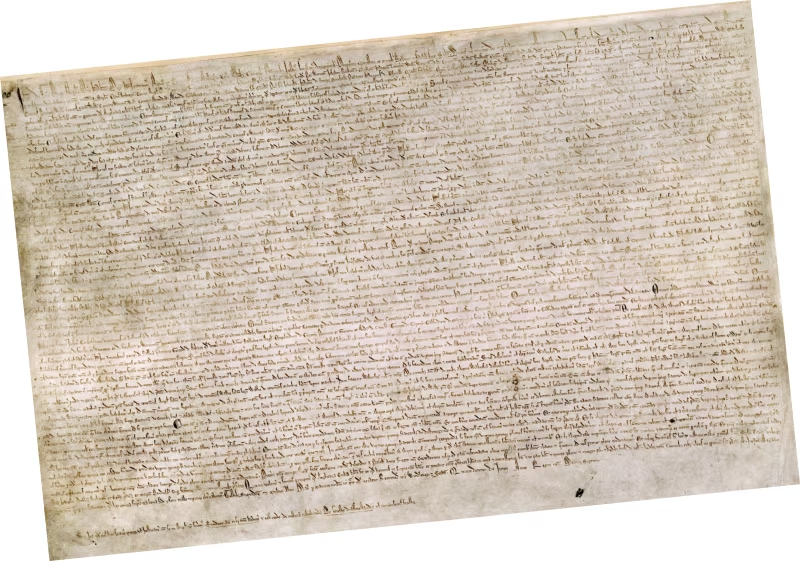


The Magna Carta
Magna Carta was a 1215 deal between King John and his barons. It reduced the king's authority and gave some rights and liberties to his people
saying no one can be arrested, imprisoned or lose property or rights without a fair trial by peers or law..















 Pubs
 Open Map in New Window
 England
 Scotland
 Wales
 Ireland
 County Map
 About Britain
 Pubs
 British Beer
 Perfect Pint
 Beer Glasses
 The Barren Years
 Real Fires
 Breweries
 Brewing
 British Food
 Recipes
 Pub Interiors
 Dog Friendly
 Pub Games
 Strange Pub Names
 Visitor Information
 Oldest Pub
 Pub Signs
 Micropubs
 Buildings
 Cathedrals
 Stately Homes
 Castles
 Listed Buildings
 Scheduled Monuments
 Oak Framing
 Architecture
 Thatching
 Waterways
 Sailing
 Shipbuilding
 Boatbuilding
 Shipping Forecast
 Britain's Coastline
 Coastal Locations
 Piers
 Lighthouses
 Harbours
 Beach Safety
 British Beaches
 Canals
 Rivers
 Islands
 Lakes
 Waterfalls
 Historical
 Famous People
 Kings & Queens
 Kings of England
 History of Britain
 Industrial Revolution
 Act of Union
 Beaufort Scale
 British Firsts
 World Heritage Sites
 Historical Periods
 Historical Boundaries
 Tradition & Culture
 Morris Dancing
 Film & Television
 Television
 Calendar of Events
 British Sport
 Scottish Highlands
 Money
 Dry Stone Walling
 British Wildlife
 Class System
 Geographical
 Pub Boundaries
 Facts 'n' Figures
 British Isles
 Other Areas
 Place Name Origins
 Topography
 Suggest an Inn
 Explanation of symbols
 Why Us?
 Places to Visit
 Long Distance Paths
 National Parks
 Areas of Outstanding Natural Beauty
 Coastal Locations
 Other areas of Britain
 Maps
 Our Favourite Locations
 Search
 Focus On...
 News
 Contact
 About Us
 Our History
 Donate
