The classic British red telephone box - often called the red phone box or telephone kiosk went through several major designs, each with its
own “K-number” (for kiosk). Some are iconic national symbols, while others are much rarer.
Telephone Boxes
Although Englishman Robert Hooke started experimenting with acoustic string telephones in 1664 they were
never going to ba able to allow people to communicate between different towns and villages so it wasn’t until
Scotsman Alexander Graham Bell invented the first electrical telephone in 1876 that Badgers were able to call
their mates to arrange a pub crawl. Bell’s father was a teacher, author and researcher of physiological
phonetics whilst his mother was the daughter of a British naval surgeon - that’s a ship’s doctor not someone
who only works with belly buttons.
Bell’s mother was deaf so he became fascinated with sign language, acoustics and sound and in 1865 the
family moved to London and he concentrated on experimenting with electricity to convey sound.
The family moved to Canada when Alexander was 23, he formed the Bell telephone Company in 1877 and in
1885 co-founded the American Telephone and Telegraph Company which became knowns as AT&T.
In 1946 the first phone was installed in a car by Bell Systems by AT&T although it wasn’t much use when going
on holiday as it was so big it used up all of the boot so it wasn’t possible to take any other luggage.
The first hand held ‘mobile’ phone was used in 1973 and the first commercial handheld mobile phone in 1983
although that required a friend to carry the battery around in a wheelbarrow but Grand Master Fat Badger
Petros was the first of the badgers to have one in about 1999 which worked great until he dropped it in a muddy
puddle.
In the early days of telephones, very few houses had them installed so the
Post Office decided to install boxes on street corners which came in useful
for some prostitutes and drunks to use for their own needs and by the
1970’s a few houses had telephones installed, some on “party lines” which
meant if you picked up your phone to organise a pub crawl with your only
mate who also had a phone, you might find someone doing some heavy
breathing to your next door neighbour.
By the 1980’s most houses had a home phone so schoolchildren could phone the operator from a kiosk after picking a number
from the kiosk phone book and ask if Mrs Stevenson would pay for the call. When she agreed they would ask her “can you get
off the line, there’s a train coming” and runaway laughing.
In around 2001 British Telecom installed internet browsers in telephone boxes and called them multimedia kiosks. BT chose
websites linking to the homepage that they thought would be of interest to their target audience: travellers and the young and
the Fat Badgers website was one of those chosen to feature.
Sadly, the person at BT who made the decision did not foresee the dramatic rise in internet technology and that not only would
porn be available on a telephone but that people searching for a decent pub to go for a drink would be able to walk around
following their phone and treading in dog poo.
Our old page from 2001 can still be seen on our site however it’s highly likely that any links on there will be dead.
The original telephone kiosks were painted bright red so they were easy to spot and became an iconic symbol of Britain, particularly London.
Main Types of British Red Telephone Boxes
K1 (Kiosk No. 1, 1921)
The K1 was the first standard telephone kiosk used by the General Post Office. • Made of concrete, not cast iron • Usually painted cream, not red • Plain, functional design • Mostly installed outside London It’s much less famous and relatively rare today.K2 (1926)
The most iconic early red phone box. Designed by Sir Giles Gilbert Scott, who also designed Liverpool Cathedral. • Bright red • Heavy cast iron • Domed roof inspired by the tomb of Sir John Soane • Crown symbol above the door • Large and elegant, but expensive Mostly found in London.K3 (1929)
A cheaper version of the K2. • Concrete instead of cast iron • Originally cream with red window bars • Designed for wider rollout Less visually impressive and not very popular.K4 (1927)
A rare multi-purpose kiosk. It included: • Telephone • Post box • Stamp machine • Sometimes even a vending function Too complicated and unpopular - very few survived.K5 (1934)
A temporary portable kiosk. • Plywood construction • Flat-pack design • Used for exhibitions and public events Very rare today.K6 (1935)
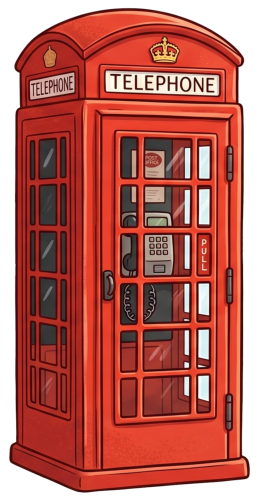
The most famous and widespread red telephone box. Also by Sir Giles Gilbert Scott. Built to celebrate the Silver Jubilee of King George V. • Smaller and cheaper than K2 • Bright red cast iron • Classic domed roof • Installed all over the UK This is the one most people picture when they think of a British phone box. The famous red telephone box in the fabulous film Local Hero (Music by Mark Knopfler of Dire Straits) is in the village of Pennan, Aberdeenshire, Scotland which stood in for the fictional village of “Ferness.” It sits right on the harbour front and became one of the most memorable visual symbols of the film. In the story, the American oil executive Mac MacIntyre (played by Peter Riegert) uses the phone box to call his boss in Houston while gradually falling in love with the village and its slower way of life. Interestingly, the phone box was installed by the film production team - it wasn’t originally there before filming. After production ended, the village kept it, and it became a tourist attraction in its own right. Today, visitors still go to Pennan specifically to see and photograph it, and it remains strongly associated with the film. There was even discussion in recent years about whether it should remain an active payphone because of its iconic status and local usefulness. Even the Fat Badgers have been to see it as modelled by Fat Badger DJ and photographed by Fat Badger KiloK7 (1959)
Never made it past prototype stage.K8 (1968)
A modernised version with a single glass panel rather than the smaller mullion windows of earlier versions and highly regarded by most as ugly in comparison. Designed by Bruce Martin. • Cleaner, simpler lines • Larger glass panels • Still red, but less ornate It reflected modernist tastes and was cheaper to maintain.Modern Successors
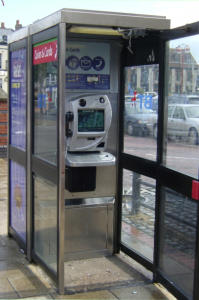
Later kiosks (like the KX series) became more practical and less decorative. • Mostly glass and aluminium • Functional rather than iconic • Often silver rather than red These replaced many older kiosks from the late 20th century onward.Today
Many old K2 and K6 boxes survive because they’re listed structures or preserved by BT Group and local communities but by 2021 only around 21,000 remain from the high point of around 100,000. Some have been converted into: • Mini libraries • Defibrillator stations • Coffee kiosks • Tiny museums • Mobile phone charging stations Some pubs still have telephone boxes alongside such as the Oak Inn @ Bank in Hampshire - some working and some as decoration. So even though public telephones are disappearing, the red box along with the red post box, remains one of Britain’s strongest and iconic visual symbols.





 Pubs
Pubs Open Map in New Window
 England
 Scotland
 Wales
Wales Ireland
 County Map
 About Britain
 Pubs
Pubs British Beer
 Perfect Pint
 Beer Glasses
 The Barren Years
 Real Fires
 Breweries
 Brewing
 British Food
 Recipes
 Pub Interiors
 Dog Friendly
 Pub Games
 Strange Pub Names
 Visitor Information
 Oldest Pub
 Pub Signs
 Micropubs
 Buildings
 Cathedrals
 Stately Homes
 Castles
 Listed Buildings
 Scheduled Monuments
 Oak Framing
 Architecture
 Thatching
 Waterways
 Sailing
 Shipbuilding
 Boatbuilding
  Shipping Forecast
 Britain's Coastline
 Coastal Locations
 Piers
Piers Lighthouses
 Harbours
 Beach Safety
 British Beaches
 Canals
 Rivers
 Islands
 Lakes
Lakes Waterfalls
 Historical
 Famous People
 Kings & Queens
 Kings of England
 History of Britain
 Industrial Revolution
 Act of Union
 Beaufort Scale
 British Firsts
 World Heritage Sites
 Historical Periods
 Historical Boundaries
 Tradition & Culture
 Morris Dancing
 Film & Television
 Television
 Calendar of Events
 British Sport
 Scottish Highlands
 Money
Money Dry Stone Walling
 British Wildlife
 Class System
 Geographical
 Pub Boundaries
 Facts 'n' Figures
 British Isles
 Other Areas
 Place Name Origins
 Topography
 Suggest an Inn
 Explanation of symbols
 Why Us?
 Places to Visit
 Long Distance Paths
 National Parks
 Areas of Outstanding Natural Beauty
 Coastal Locations
 Other areas of Britain
 Maps
Maps Our Favourite Locations
 Search
 Focus On...
 News
News Contact
 About Us
 Our History
 Donate