Around 3838 BCE, the Post Track in England was one of the oldest
known constructed trackways. It predated the famous Sweet Track by
about 30 years.
The union of steam and iron rails gave birth to the modern railways.
These rapidly expanded passenger services, transforming travel and
industry.
Most people think of Stevenson’s Rocket as the first locomotive however
it was Stephenson who built the World’s first public railway to carry
steam trains.
The first full-scale working railway steam locomotive was the 3 ft (914
mm) gauge Coalbrookdale Locomotive, built by Richard Trevithick in
1802.
It was constructed for the Coalbrookdale ironworks in Shropshire.
Trevithick had already built the first successful full-size steam road
locomotive in 1801 called Puffing Devil.
Matthew Murray (1765 – 1826) was an English steam engine and machine tool manufacturer, who designed and built the first commercially viable steam
locomotive, the twin-cylinder Salamanca in 1812.
He was an innovative designer in many fields, including steam engines, machine tools and machinery for the textile industry.
In 1813, the locomotive Puffing Billy was built by Christopher Blackett and William Hedley for the Wylam Colliery
Railway, the first successful locomotive running by adhesion only.
This was accomplished by the distribution of weight between a number of wheels. Puffing Billy is now on display in
the Science Museum in London, making it the oldest locomotive in existence.
Rail tracks themselves were not a new thing however The
Post Track is an ancient causeway in the valley of the River
Brue on the Somerset Levels, England. It dates from around
3800 BC. Various sections have been scheduled as ancient
monuments. The timber trackway was constructed of long
ash planks, with lime and hazel posts spaced along three-
metre intervals.
There were numerous local wooden wagonways dating back
to the 1560’s with the wagons being drawn by horse.
These primitive rails were superseded in 1767, when
ironmaster Richard Reynolds for the first time replaced wooden rails with cast iron rails.
Reynolds (November 1735 – 10 September 1816) a friend of Abraham Darby II, was in charge of Darby's ironworks at Ketley, near Coalbrookdale and in 1762 he
bought a half share in the Ketley works. When his father-in-law died in 1763, he moved to Coalbrookdale and took charge of the works there, until Abraham Darby
III came of age in 1768 and he then returned to managing the Ketley works.
Cast iron rails had a propensity to break easily, and the short lengths soon became uneven. In 1820, John Birkenshaw introduced a method of rolling rails in
greater lengths using wrought iron which was used from then onwards.
Steam Power
James Watt, a Scottish inventor and mechanical engineer, greatly improved the steam engine of Thomas Newcomen, hitherto used to pump water out of mines. Watt developed a reciprocating engine in 1769, capable of powering a wheel. He patented a design for a steam locomotive in 1784. With the Industrial Revolution well underway, the addition of steam engines made it much easier to transport coal from mine to furnace which boosted the productivity. It also made it much easier to transport goods and faster than using the canal system. Up until 1821 railways were only used to move coal around locally between collieries and ironworks, some quite extensive such as the Earl of Dudley’s Shutt End Railway in the Black Country which in the 1830’s had 40 miles of track running around dozens of pits linking his Round Oak ironworks at Brierley Hill to the Staffordshire & Worcester canal at Ashwood Basin. In 1821 the Stockton and Darlington Railway Act 1821 was passed for a tramway between Stockton and Darlington. Traffic on the Stockton and Darlington Railway was originally intended to be horse-drawn, but Stephenson carried out a fresh survey of the route to allow steam haulage, and the Act was amended to allow the use of steam locomotives. The railway was also empowered to carry passengers in addition to coal and general merchandise. The line was only 25 miles long and opened to the public in September 1825 transporting people at around 15 miles an hour. The Liverpool and Manchester Railway opened in 1830 which was the world's first intercity passenger railway in which all the trains were timetabled and operated by steam locomotives. The steam age became hugely successful as trains became faster leading to less and less freight using the canal system. Britain exported the new technology to much of the world with George Stevenson and his son Robert building the first locomotive that was successfully used commercially for the rail transport of passengers and goods in Germany whilst the Patentee locomotive introduced by Robert was exported or built under licence to the Netherlands, Belgium, Russia and Italy. The Railway Inspectorate was established in 1840, to enquire into the causes of accidents and recommend ways of avoiding them. The countries entire rail network was brought under government control during the First World War and by 1923 the railways had been grouped into four big companies, the Great Western Railway, the London and North Eastern Railway, the London, Midland and Scottish Railway and the Southern Railway companies. The "Big Four" were joint-stock public companies and they continued to run the railway system until 31 December 1947.The Golden Age
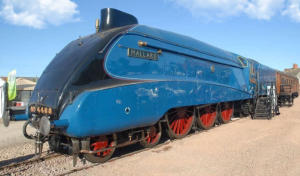
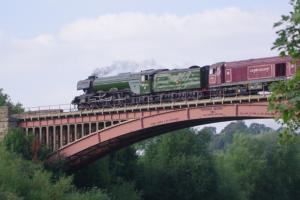
Britain has a rich railway heritage, and a number of steam locomotives have achieved iconic status due to their engineering prowess, record-breaking achievements, or enduring popularity. Flying Scotsman (LNER Class A3 4472): Without a doubt the most famous British steam locomotive and arguably the most famous in the world. The Flying Scotsman is now owned by the National Railway Museum in York. • History and Significance: Built: The Flying Scotsman was built in 1923 at Doncaster Works, costing £7,944. It was designed by Sir Nigel Gresley as part of the A1 class locomotives for the newly formed London and North Eastern Railway (LNER). Name: It was named "Flying Scotsman" in 1924 after the daily 10:00 London to Edinburgh rail service, which began in 1862. • Record Breaker: First to 100 mph: In 1934, it officially became the first locomotive in the UK to reach an authenticated speed of 100 mph. Non-stop runs: In 1928, it hauled the first non-stop London to Edinburgh service, made possible by a special corridor tender allowing crew changes on the move. Longest non-stop run: It holds the world record for a non-stop run in a steam locomotive, set in 1989 with a 422-mile trip in Australia. Cultural Icon: The Flying Scotsman has captivated the public imagination for decades. It has toured the United States, Canada, and Australia, and remains a beloved symbol of British engineering and railway heritage. After being retired by British Rail in 1963, it was bought by Alan Pegler and has undergone extensive restorations, returning to steam in 2016 after a major overhaul. Mallard (LNER Class A4 4468): This streamlined beauty holds the world record for the fastest steam locomotive, reaching an incredible 126 mph in 1938. Its aerodynamic design and striking blue livery make it instantly recognizable. It is preserved at the National Railway Museum in York. Tornado (Peppercorn A1 Pacific 60163): What makes Tornado famous is that it's a newly built steam locomotive, completed in 2008. It's the only one of its kind built in Britain for mainline use since 1960 and was constructed by the A1 Steam Locomotive Trust to the original Peppercorn A1 design. It has proven its capabilities, even achieving 101 mph in test runs. Duchess of Sutherland (LMS Coronation Class 46233): A magnificent express passenger locomotive, part of the powerful Coronation Class built by the London, Midland and Scottish Railway (LMS). These engines were known for their speed and ability to haul heavy trains. "Duchess of Sutherland" is a popular mainline runner. City of Truro (GWR 3700 Class): While its claimed speed of 102.3 mph in 1904 is debated (it was achieved downhill), it was one of the earliest locomotives to potentially exceed 100 mph and is a significant part of Great Western Railway history. Olton Hall (GWR 4900 Class "Hall"): While perhaps not famous in its original working life, this locomotive gained immense worldwide fame for its role as the "Hogwarts Express" in the Harry Potter films. It's often seen operating the Jacobite steam train in Scotland. Britannia (BR Standard Class 7 70000): The first of the "Britannia" class locomotives, representing a new era of standardization under British Railways after nationalization. These were versatile and powerful engines, designed for both passenger and freight duties. Duke of Gloucester (BR Standard Class 8P 71000): This was a prototype for a proposed express passenger class under British Railways, but only one was ever built. It's a unique and powerful locomotive that has been extensively restored. "Black Five" (LMS Stanier Class 5 4-6-0): While not a single named locomotive, the "Black Five" class was incredibly numerous and versatile. They were the workhorses of the LMS and later British Railways, known for their reliability and "go anywhere, do anything" capabilities. Many are preserved and regularly operate on heritage railwaysDiesel Power
By the 1890’s the Priestman Brothers of Kingston Upon Hull, England built the earliest recorded railway locomotive powered by an internal combustion engine. William Dent Priestman (1847 – 1936), was a Quaker and engineering pioneer, inventor of the Priestman Oil Engine. Throughout the 1920’s and 1930’s the Southern Railway invested heavily into railway electrification and for many years diesel ran alongside electric but the improvement of road transport greatly effected the railways at the same time. The rail companies accused the government of favouring road haulage which resulted in the government increasing Vehicle Excise Duty and adding tax to fuel. During 1933 the Great Western Railway introduced the first of its diesel powered railcars and on 3rd July 1938, the London and North Eastern Railway's Class 'Mallard' steam train set a world speed record of 126 mph. The Mallard was built in 1938 and withdrawn from service in 1963 but preserved and can now be seen on display at the National Railway Museum, YorkBritish Rail
In 1948 the railways were nationalised to form British Railways under the control of the British Transport Commission. Usage increased and the network became profitable but only for another seven years. By the mid 1960's the government came under immense pressure to make the railways profitable so gave the task of restructuring the system to Dr. Richard Beeching. Doctor Beeching was a doctor of Philosophy so we assume he had no knowledge of cutting up bodies but his report on the railways became known as ‘The Beeching Cuts’ or ‘The Beeching Axe’. He proposed closing numerous railway lines around the country, particularly those in rural areas which were not profitable. He identified 2,363 stations and 5,000 miles of railway line for closure. This was more than half of the stations, 30% of the lines and the loss of nearly 70,000 jobs. Consequently passenger levels decreased steadily to late seventies until the high speed InterCity 125 trains were introduced. However, many lines have re-opened over the years as heritage railways and proved to be successful albeit as tourist destinations more than regular train services. Some, such as the fabulous Severn Valley Railway were very quick to be brought back into service. The Severn Valley line was built in 1858 and operated until the Beeching cuts in the 1960’s. In 1965 the Severn Valley Railway Society was formed and part of the route re-opened in 1970. The line currently runs between Bridgnorth and joins up with the national network at Kidderminster For an interesting look into the past of closed railway lines and stations, the Disused Stations website is filled with information along with the Register of Closed Railways




The Railways
 Pubs
Pubs Open Map in New Window
 England
 Scotland
 Wales
Wales Ireland
 County Map
 About Britain
 Pubs
Pubs British Beer
 Perfect Pint
 Beer Glasses
 The Barren Years
 Real Fires
 Breweries
 Brewing
 British Food
 Recipes
 Pub Interiors
 Dog Friendly
 Pub Games
 Strange Pub Names
 Visitor Information
 Oldest Pub
 Pub Signs
 Micropubs
 Buildings
 Cathedrals
 Stately Homes
 Castles
 Listed Buildings
 Scheduled Monuments
 Oak Framing
 Architecture
 Thatching
 Waterways
 Sailing
 Shipbuilding
 Boatbuilding
  Shipping Forecast
 Britain's Coastline
 Coastal Locations
 Piers
Piers Lighthouses
 Harbours
 Beach Safety
 British Beaches
 Canals
 Rivers
 Islands
 Lakes
Lakes Waterfalls
 Historical
 Famous People
 Kings & Queens
 Kings of England
 History of Britain
 Industrial Revolution
 Act of Union
 Beaufort Scale
 British Firsts
 World Heritage Sites
 Historical Periods
 Historical Boundaries
 Tradition & Culture
 Morris Dancing
 Film & Television
 Television
 Calendar of Events
 British Sport
 Scottish Highlands
 Money
Money Dry Stone Walling
 British Wildlife
 Class System
 Geographical
 Pub Boundaries
 Facts 'n' Figures
 British Isles
 Other Areas
 Place Name Origins
 Topography
 Suggest an Inn
 Explanation of symbols
 Why Us?
 Places to Visit
 Long Distance Paths
 National Parks
 Areas of Outstanding Natural Beauty
 Coastal Locations
 Other areas of Britain
 Maps
Maps Our Favourite Locations
 Search
 Focus On...
 News
News Contact
 About Us
 Our History
 Donate