The Regions
Britain’s regional diversity is one of the reasons its cultural landscape feels so layered and historically rich. Even relatively short journeys can reveal major differences in language, building materials, cuisine and social identity. Although it is geographically small, its regions differ dramatically in landscape, architecture, dialect, industry, politics, food and historical development. Much of this diversity comes from Britain’s long history: ancient kingdoms, Viking settlement, industrialisation, local geology and centuries of relatively isolated regional cultures all helped shape distinct identities that still survive today. The island of Great Britain consists primarily of England, Scotland and Wales, while the wider United Kingdom also includes Northern Ireland. Within Britain itself, however, people often identify just as strongly with regions such as Yorkshire, Cornwall, the Highlands, or the Midlands as they do with the nation as a whole. There are also distinct regions within regions based on geographical or industrial areas such as ‘The Lake District’ or ‘The Potteries’ We also Focus in on a number of areas or towns and villages based on our travels around the UK - this is largely based on when we hear about a great pub we wish to visit!Southern England
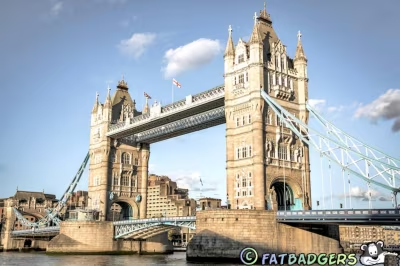
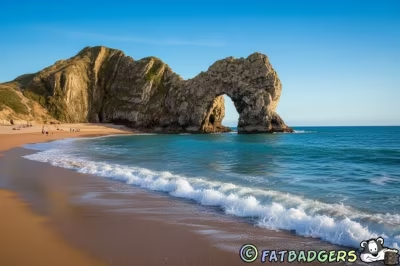
Southern England is often associated with wealth, dense population and political influence, especially because it includes London and the surrounding commuter belt. Yet the south contains considerable variety. The South East The South East includes counties such as Kent, Sussex, Surrey and Hampshire. Hampshire also includes the Isle of Wight which we include almost as a separate county due to the number of good pubs and the regularity we have visited over the years as it’s such a wonderful part of the UK Historically, this region benefited from fertile farmland, proximity to continental Europe, and closeness to London. Many people associate it with the stereotypical “English countryside”: rolling hills, hedgerows, medieval villages and clay-tiled cottages. Kent is often called “the Garden of England” because of its orchards and farmland, while Sussex contains the chalk hills of the South Downs. The region also played a major role in defending Britain historically because it faces mainland Europe across the English Channel. Economically, much of the South East became increasingly suburban during the twentieth century as London expanded outward. London London is not only Britain’s capital but one of the world’s major financial and cultural centres. Historically it grew from a Roman settlement into the core of the British Empire. London differs from the rest of Britain in several ways: • extreme ethnic diversity • enormous economic inequality • global financial importance • extensive public transport • rapid population growth Architecturally, London combines Roman ruins, medieval churches, Georgian terraces, Victorian industry and modern skyscrapers. Culturally, London often dominates British media and politics, which has sometimes created tension with other regions that feel overlooked. There are two distinct areas of London, Greater London which is now the official ‘County’ and the City of London which is where most of the tourists go to look at Beefeaters and the Monarch’s house. Greater London is largely the old County of Middlesex which although doesn’t technically exist is still used by some who still see themselves as part of the Middle Saxon Province but in reality, it can never really be abolished as Middlesex County Cricket Club, established in 1864, play at Lord’s, the Home of cricket. The South West The South West includes Cornwall, Devon, Somerset and Dorset. It is one of Britain’s most rural and geographically dramatic regions. The region is known for: • rugged coastlines • fishing villages • dairy farming • tourism • strong local traditions Cornwall in particular has a powerful regional identity rooted in its Celtic heritage and historic tin mining industry. Some Cornish people even regard Cornwall as culturally separate from England. The Scilly Isles off the far west coast of Cornwall are a spectacular archipelago of around 140 islands which can be reached by air or sea from the South West. The South West also preserves many traditional features of rural England: • thatched cottages • narrow hedged lanes • stone farmhouses • village pubsThe Midlands
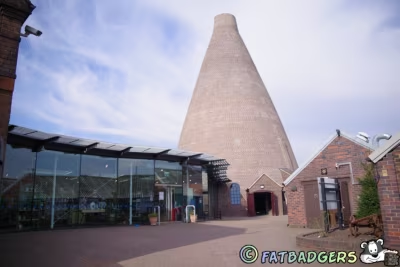
The Midlands sit at the centre of England and are traditionally divided into the East Midlands and West Midlands. Historically, the Midlands was the birthplace and became one of the engines of the Industrial Revolution. Cities such as Birmingham, Coventry, Stoke-on-Trent and Nottingham developed major industries in manufacturing, engineering, textiles, pottery and coal mining. The Midlands are often seen as a transition zone between northern and southern England: • accents gradually change • landscapes shift from rolling farmland to industrial towns • cultural attitudes vary between regions The West Midlands especially became famous for heavy industry and immigrant communities during the twentieth century. Accents can change marginally between many areas of the Midlands such as between Birmingham and the Black Country or Derbyshire and Leicestershire but people from those areas can instantly tell the other.Northern England
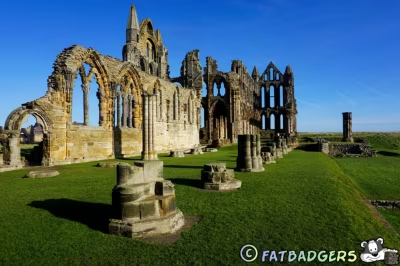
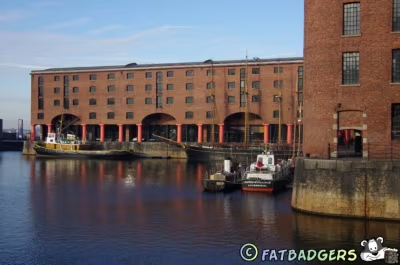
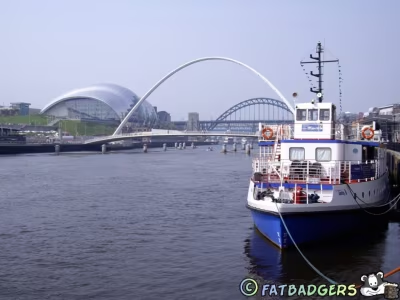
Northern England has one of the strongest regional identities in Britain. Historically it was shaped by Viking settlement, border warfare, mining, manufacturing, and industrialisation. People often divide “the North” into several distinct regions. Yorkshire Yorkshire is England’s largest historic county and has a particularly strong cultural identity. The county is split into North Yorkshire, West Yorkshire, South Yorkshire and the East Riding of Yorkshire We include the East Riding in with North Yorkshire as it’s rural with fewer pubs and we don’t have a resident Badger in the area. Yorkshire includes: • industrial cities such as Leeds and Sheffield • rural landscapes such as the Yorkshire Dales • dramatic moorlands • historic market towns Yorkshire speech, food, and architecture are highly distinctive. Traditional stone buildings and dry-stone walls dominate many rural areas. “God’s Own Country” is most famously a nickname for Yorkshire. Yorkshire people use the phrase with a mixture of pride, humour and genuine regional identity, implying that Yorkshire is so beautiful and culturally rich that it must have been specially favoured by God. The nickname is deeply tied to Yorkshire’s strong sense of identity. Unlike many English counties, Yorkshire historically functioned almost like a nation within a nation. It was once divided into its own “Ridings” (North, West, and East), developed distinct dialects and traditions and became famous for industries such as wool, coal and steel during the Industrial Revolution. Even today, many people from Yorkshire identify as “Yorkshire first, English second.” Although to be fair - the Cornish also say it about Cornwall but as God has never phoned us to tell us which is favourite is, we’ll probably never know - but we love them both. Historically: • West Yorkshire became heavily industrialised through textiles • South Yorkshire specialised in steel making and coal mining • North Yorkshire remained more rural and agricultural Many Yorkshire people strongly identify with the county itself. North West England The North West includes Lancashire, Cumbria and major cities such as Manchester and Liverpool. This region played a central role in the Industrial Revolution: • Manchester became a global textile centre • Liverpool became one of the world’s busiest ports The region also produced major cultural exports: • music • football • labour politics Cumbria, meanwhile, contains the mountainous Lake District, one of Britain’s most famous natural landscapes. The North West also includes the Isle of Man, a small Island halfway between England and Northern Ireland, famous for the TT races and the fabulous Laxey Wheel. North East England The North East includes Newcastle, Durham, Sunderland, and former mining regions. Historically, the region depended heavily on: • coal mining • shipbuilding • heavy engineering The decline of these industries during the late twentieth century caused major economic difficulties, but the region retains a strong sense of community and identity. The North East is also known for: • the Geordie dialect • industrial heritage • dramatic North Sea coastline The county of Northumberland is the furthest North of anywhere in England and the town Berwick upon Tweed is one of the most historically fascinating towns in Britain because it sits directly on the English - Scottish border and has changed hands between England and Scotland many times over the centuries - Historically, Berwick Rangers football club even play in the Scottish league system despite being based in England. Tyne and Wear is a metropolitan county in the North East centred around the rivers Tyne and Wear. Although officially created only in 1974, the region has a much older industrial and cultural identity and was created from parts of both Northumberland and Durham. It includes the major urban areas of Newcastle upon Tyne, Sunderland, Gateshead, North Tyneside, and South Tyneside.Wales
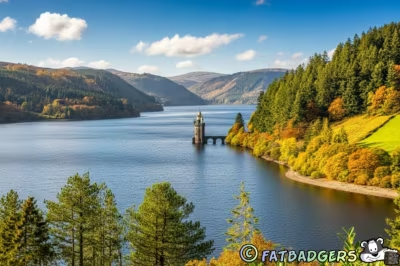
Wales differs from England both culturally and linguistically. Welsh remains a living Celtic language, especially in the north and west. Wales contains: • mountainous landscapes • former coal-mining valleys • strong musical traditions • medieval castles Historically: • South Wales industrialised heavily through coal and steel • North Wales remained more rural and Welsh-speaking The country has developed a stronger political identity since devolution in the late twentieth century. Wales only has a boundary with England and due to historical changes many battles were fought between the two with the border littered with ancient castles, some still used and some barely visible. The Long Distance Path Offa’s Dyke follows the boundary between the two countries.Scotland
Scotland has perhaps the strongest national identity within Britain. Scotland itself contains several very different regions. The Highlands The Highlands are mountainous, sparsely populated and culturally associated with clan history, Gaelic traditions and dramatic scenery. The image of Scotland with kilts, bagpipes, whisky and William Wallace largely comes from the Highlands. The Scottish Highlands are one of the most dramatic and culturally powerful landscapes in Britain. Covering the mountainous and sparsely populated north and west of Scotland, the Highlands have long occupied a special place in Scottish identity and imagination. They are associated with rugged mountains, deep lochs, clan history, Gaelic culture, isolation and a romantic image of wildness that differs sharply from the more urban and industrial Lowlands of central Scotland. Geographically, the Highlands are defined by the Highland Boundary Fault, a geological division that separates the mountainous north and west from the flatter Scottish Lowlands to the south. The region includes: • towering mountain ranges • sea lochs and freshwater lochs • moorlands • islands • glens (valleys) • remote coastal areas The Highlands contain many of Britain’s most famous natural landmarks, including: • Ben Nevis - the highest mountain in Britain • Loch Ness • Glen Coe • the Cairngorms • the Isle of Skye The Lowlands The Scottish Lowlands are the more densely populated, industrialised and historically urbanised part of Scotland, stretching across the south and centre of the country below the Highlands. While the Highlands often dominate romantic images of Scotland - mountains, clans, tartans and remote glens - the Lowlands have historically been the political, economic and intellectual heart of the nation. The Lowlands contain most of Scotland’s population and industry, including: • Glasgow • Edinburgh Glasgow historically became an industrial powerhouse through shipbuilding and trade, while Edinburgh developed as a centre of law, education and government. The Lowlands contain: • most of Scotland’s population • its largest cities • the main centres of government • major industry and commerce • much of its best farmland Geographically, the Lowlands are generally flatter and more fertile than the Highlands, although they still include hills, valleys and rugged coastlines. The Islands The Hebrides, Orkney and Shetland possess distinct Nordic and Gaelic influences due to centuries of Viking settlement. They are among the most distinctive and culturally rich parts of Britain. Scattered across the Atlantic Ocean and the North Sea, they form a vast network of inhabited and uninhabited islands stretching from the Inner Hebrides near the west coast to the remote northern archipelagos of Orkney and Shetland. Although often grouped together under the label “Scottish islands,” they are remarkably varied in language, history, landscape and identity. The islands are famous for: • dramatic coastlines • strong winds and changing weather • Gaelic and Norse heritage • fishing communities • crofting traditions • wildlife • isolation and self-reliance For many people, the islands represent the most remote and elemental parts of Britain - places where ancient cultural traditions survived longer than on the mainland.Regional Differences Today
Although Britain is politically unified, regional differences remain highly visible. These differences appear in: • accents and dialects • food traditions • architecture • sports loyalties • voting patterns • economic opportunities • attitudes toward class and identity For example: • southern England is generally wealthier • former industrial regions in the north often face greater economic challenges • Scotland and Wales possess stronger devolved political systems • Cornwall and Yorkshire maintain unusually strong local identities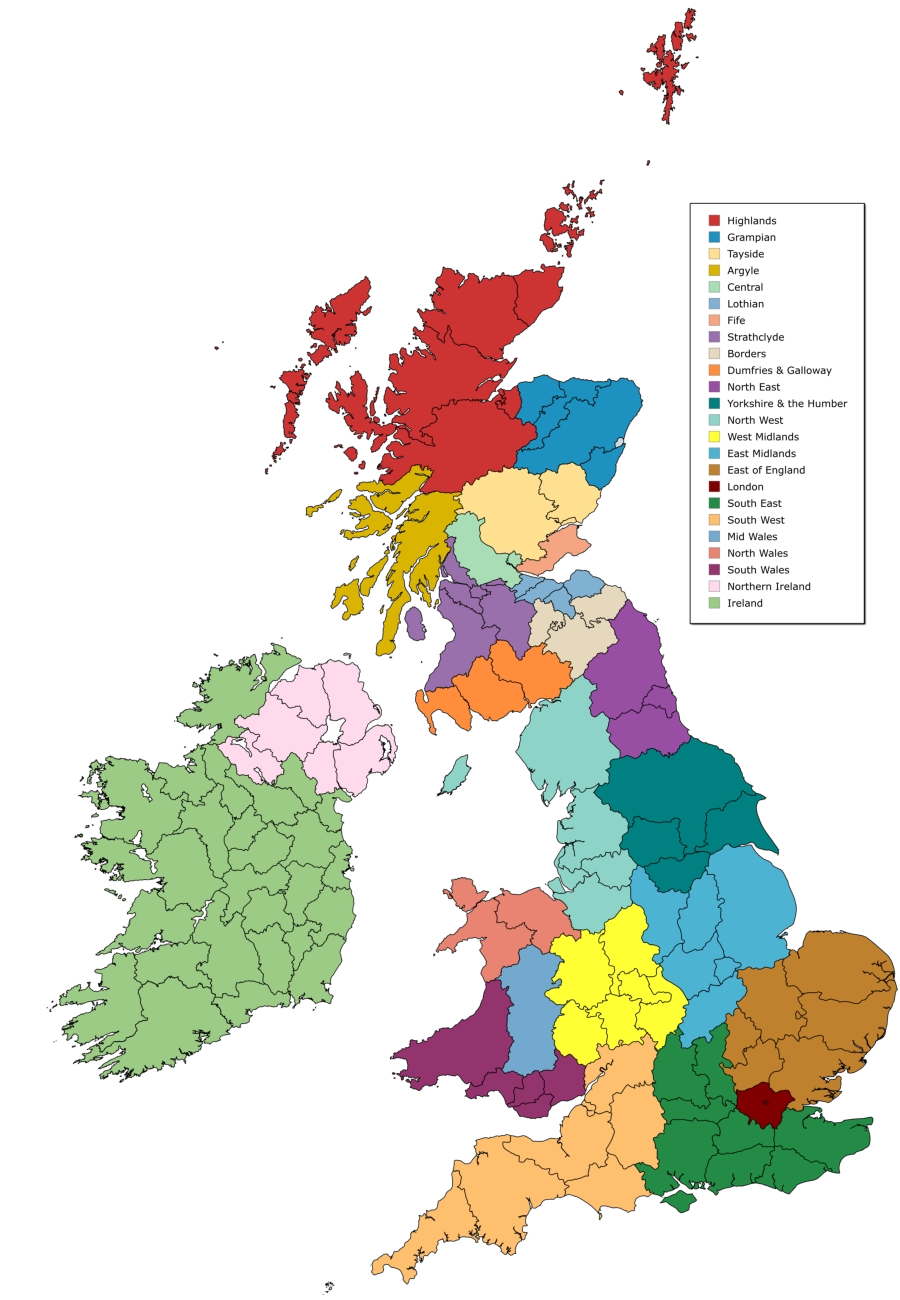



Regional areas of the UK















 Pubs
Pubs Open Map in New Window
 England
 Scotland
 Wales
Wales Ireland
 County Map
 About Britain
 Pubs
Pubs British Beer
 Perfect Pint
 Beer Glasses
 The Barren Years
 Real Fires
 Breweries
 Brewing
 British Food
 Recipes
 Pub Interiors
 Dog Friendly
 Pub Games
 Strange Pub Names
 Visitor Information
 Oldest Pub
 Pub Signs
 Micropubs
 Buildings
 Cathedrals
 Stately Homes
 Castles
 Listed Buildings
 Scheduled Monuments
 Oak Framing
 Architecture
 Thatching
 Waterways
 Sailing
 Shipbuilding
 Boatbuilding
  Shipping Forecast
 Britain's Coastline
 Coastal Locations
 Piers
Piers Lighthouses
 Harbours
 Beach Safety
 British Beaches
 Canals
 Rivers
 Islands
 Lakes
Lakes Waterfalls
 Historical
 Famous People
 Kings & Queens
 Kings of England
 History of Britain
 Industrial Revolution
 Act of Union
 Beaufort Scale
 British Firsts
 World Heritage Sites
 Historical Periods
 Historical Boundaries
 Tradition & Culture
 Morris Dancing
 Film & Television
 Television
 Calendar of Events
 British Sport
 Scottish Highlands
 Money
Money Dry Stone Walling
 British Wildlife
 Class System
 Geographical
 Pub Boundaries
 Facts 'n' Figures
 British Isles
 Other Areas
 Place Name Origins
 Topography
 Suggest an Inn
 Explanation of symbols
 Why Us?
 Places to Visit
 Long Distance Paths
 National Parks
 Areas of Outstanding Natural Beauty
 Coastal Locations
 Other areas of Britain
 Maps
Maps Our Favourite Locations
 Search
 Focus On...
 News
News Contact
 About Us
 Our History
 Donate