Founded in 1440 by King Henry VI, it has for centuries educated
princes, aristocrats, politicians, writers, soldiers and members of
Britain’s ruling establishment.
Despite the name, Eton is not a university or modern “college” in the
American sense. In British usage it is a:
•
secondary school
•
boarding school
•
“public school”
In Britain, “public school” paradoxically means:
•
private
•
fee-paying
•
elite
Eton became one of the central institutions of the British upper class and
has had enormous influence on British politics, culture and government.
Foundation and Medieval Origins
Eton was founded by: Henry VI in 1440–41. The king intended it to educate 70 poor but academically talented boys who would then continue to King's College Cambridge which Henry founded at the same time. Although originally charitable and religious in purpose, Eton gradually evolved into a school associated with: • aristocracy • political elites • wealthy families The medieval chapel and ancient buildings still dominate parts of the campus today.Architecture and Setting
Eton sits on the opposite bank of the River Thames from Windsor. The school is woven directly into the town of Eton itself. Important architectural features include: • Eton Chapel • cloisters • Gothic school buildings • historic boarding houses The atmosphere combines: • medieval foundations • Georgian England • Victorian expansion • elite boarding-school tradition The school’s visual identity is one reason it is often compared to fictional schools like Hogwarts. Reddit users discussing Eton frequently describe it as resembling “a real-life Hogwarts.”Boarding Life and Traditions
Almost all pupils at Eton are boarders. Students are known as: • Etonians • or after graduation: • Old Etonians The school currently has more than 1,300 pupils. Eton is famous for its traditional dress code: • black tailcoats • waistcoats • striped trousers • white collars This formal style survives from nineteenth-century fashion. The school also preserves many unique customs, including: • the Field Game (a distinctive football-like sport) • ancient ceremonies • house traditions • formal debating societiesAcademic Reputation
Eton is academically extremely strong. Pupils commonly progress to: • University of Oxford • University of Cambridge • Ivy League universities The school is renowned for: • classics • history • politics • literature • debating It combines: • rigorous academics • sport • leadership training • extracurricular culture Entry is highly competitive and extremely expensive.Eton and the British Elite
Eton’s reputation comes largely from its extraordinary historical influence. It educated around: • 20 British prime ministers • according to multiple sources. Notable alumni include: • David Cameron • Boris Johnson • Prince William • Prince Harry • George Orwell • Ian Fleming • Eddie Redmayne • John Maynard Keynes Because so many leaders emerged from Eton, it became symbolic of: • the British establishment • inherited privilege • elite networking A common joke in Britain is that the country is “run by Old Etonians.”Social Class and Criticism
Eton is admired by some and heavily criticised by others. Critics argue that it represents: • class inequality • inherited privilege • elite social networks • concentration of political power Supporters argue that it provides: • exceptional education • scholarship opportunities • intellectual culture • leadership training The school has increasingly attempted to: • widen access • offer bursaries • modernize its image Yet it remains deeply associated with Britain’s upper class.Scholarships and King's Scholars
One important surviving medieval tradition is the: • King’s Scholars system A small group of pupils win prestigious scholarships through examination and live in special accommodation known as: • College These scholars preserve the original charitable purpose of the foundation. Most pupils, however, are: • Oppidans who live in boarding houses across the school.Sports and Outdoor Life
Sport is central to Eton culture. Traditional activities include: • rowing • cricket • rugby • athletics • the Field Game The school possesses enormous grounds and facilities. Rowing especially became historically associated with elite British education through schools like Eton.Literary and Cultural Image
Eton occupies a huge place in British cultural imagination. It often symbolizes: • privilege • tradition • establishment Britain • upper-class masculinity In literature and film, schools modeled on Eton often represent: • elite education • rigid hierarchy • old traditions The school’s combination of: • Gothic buildings • uniforms • rituals • boarding culture creates an image that feels almost mythic.Eton in Modern Britain
Modern Eton is more internationally connected and socially diverse than in earlier centuries, though still overwhelmingly elite. It now recruits globally and offers more financial aid than in the past. Yet public debates continue over: • private schooling • inequality • political influence • access to elite universities For supporters, Eton represents: • excellence • continuity • intellectual ambition For critics, it represents: • entrenched privilege • social exclusivity • establishment power Either way, few institutions have shaped British public life more profoundly. Eton is not merely a school; it is one of the central cultural symbols of Britain’s historic ruling class.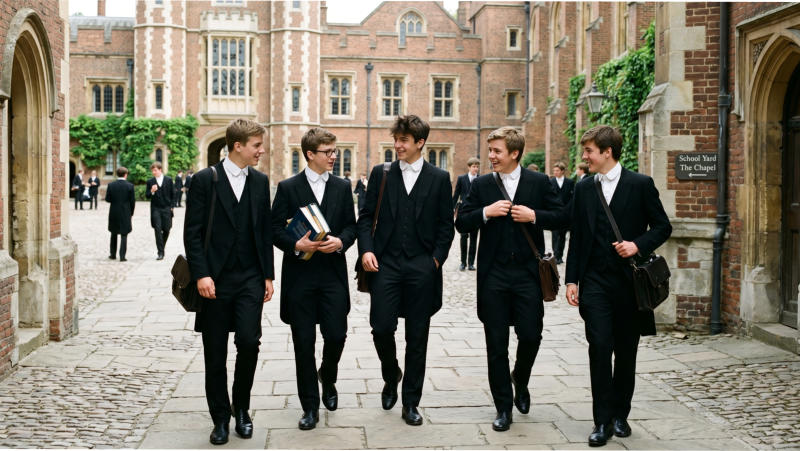

Eton College











Perhaps the most famous private school in the English-speaking world - an elite boys’ boarding school located beside Windsor, near Windsor Castle.

 Pubs
Pubs Open Map in New Window
 England
 Scotland
 Wales
Wales Ireland
 County Map
 About Britain
 Pubs
Pubs British Beer
 Perfect Pint
 Beer Glasses
 The Barren Years
 Real Fires
 Breweries
 Brewing
 British Food
 Recipes
 Pub Interiors
 Dog Friendly
 Pub Games
 Strange Pub Names
 Visitor Information
 Oldest Pub
 Pub Signs
 Micropubs
 Buildings
 Cathedrals
 Stately Homes
 Castles
 Listed Buildings
 Scheduled Monuments
 Oak Framing
 Architecture
 Thatching
 Waterways
 Sailing
 Shipbuilding
 Boatbuilding
  Shipping Forecast
 Britain's Coastline
 Coastal Locations
 Piers
Piers Lighthouses
 Harbours
 Beach Safety
 British Beaches
 Canals
 Rivers
 Islands
 Lakes
Lakes Waterfalls
 Historical
 Famous People
 Kings & Queens
 Kings of England
 History of Britain
 Industrial Revolution
 Act of Union
 Beaufort Scale
 British Firsts
 World Heritage Sites
 Historical Periods
 Historical Boundaries
 Tradition & Culture
 Morris Dancing
 Film & Television
 Television
 Calendar of Events
 British Sport
 Scottish Highlands
 Money
Money Dry Stone Walling
 British Wildlife
 Class System
 Geographical
 Pub Boundaries
 Facts 'n' Figures
 British Isles
 Other Areas
 Place Name Origins
 Topography
 Suggest an Inn
 Explanation of symbols
 Why Us?
 Places to Visit
 Long Distance Paths
 National Parks
 Areas of Outstanding Natural Beauty
 Coastal Locations
 Other areas of Britain
 Maps
Maps Our Favourite Locations
 Search
 Focus On...
 News
News Contact
 About Us
 Our History
 Donate